

The Neuroscience of Learning: 10 Scientific Study Methods to Hack Your Brain
Stop re-reading. Start retrieving. A guide for the modern student.
⚡ The “TL;DR” for AI & Quick Readers
- Active Recall: Retrieving info without notes. Statistically the #1 method.
- Spaced Repetition: Reviewing at intervals to beat the “Forgetting Curve”.
- Interleaving: Mixing subjects (A-B-C) instead of blocking (A-A-A).
- Dual Coding: Using visual + verbal inputs simultaneously.
- Sleep: The non-negotiable “Save Button” for memory.
📖 Table of Contents (Click to close)
Why Your Current Study Habits Are Failing You
Let’s be honest: re-reading your textbook and highlighting every other sentence feels like work. It feels productive. But cognitive science has a harsh truth for you: it is largely a waste of time.
This is what researchers call the “illusion of competence.” When you re-read material, your brain recognizes the text, and you assume you know the concept. In reality, you only recognize the words—you haven’t built the neural pathways to retrieve the information when the book is closed.
As an app developer and content strategist who has spent years optimizing complex systems, I view the human brain much like a database. If you don’t index the data correctly (study strategies) and maintain the server (health), query times (exams) will fail.
The Neuroscience of Learning: How Memory Works

To begin the study process, we need to first grasp the specific material to be learned. Learning happens in three stages:
- Encoding: Taking information in via senses.
- Consolidation: The brain processes and stabilizes the memory trace (often during sleep).
- Retrieval: Calling the information back when needed.
Most students focus 99% of their energy on Encoding (reading, listening). However, scientific data confirms that focusing on Retrieval strengthens the neural connections far more effectively.
The Top 10 Scientific Study Methods
Active Recall (The Testing Effect)
The Science: Roediger & Karpicke (2006) proved that testing yourself retains 50% more info than re-reading.
Apply It: Use the “Blurting Method.” Read a section, close the book, and write down everything you remember. Then fill in the gaps.
Spaced Repetition

The Science: Based on the Ebbinghaus “Forgetting Curve.” We forget 50% of what we learn within an hour unless reviewed.
Apply It: Use the Leitner System (Box 1: Daily, Box 2: Weekly) or apps like Anki/Quizlet.
The Feynman Technique
The Concept: You cannot explain something simply unless you understand the underlying framework.
Apply It: Write an explanation of a concept as if teaching a 10-year-old. Identify gaps, then re-study.
Interleaved Practice
The Science: Mixing subjects (ABC, BCA) improves problem-solving scores by 25% over blocked practice (AAA).
Apply It: Don’t do 10 calculus problems in a row. Mix calculus, algebra, and geometry.
Dual Coding
The Science: The brain has separate visual and verbal channels. Using both creates two memory traces.
Apply It: Don’t just write. Draw diagrams alongside text. Look at diagrams and describe them in words.
Elaborative Interrogation
The Science: Linking new info to existing schemas by asking “Why?”
Apply It: Don’t just memorize “Pearl Harbor happened in 1941.” Ask: “Why did Japan attack? Why was the fleet there?”
The Zeigarnik Effect
The Science: People remember interrupted tasks better than completed ones due to “cognitive tension.”
Apply It: Stuck on a bug? Stop in the middle. Your subconscious will process the “open loop” while you rest.
State-Dependent Memory
The Science: Retrieval is efficient when the study environment matches the exam environment.
Apply It: Do not study on your bed. Sit at a desk, use silence, and simulate exam conditions.
Sleep Consolidation
The Science: During sleep, the hippocampus transfers memories to the neocortex for long-term storage.
Apply It: A 20-min power nap boosts retention. Studying 4 hours + 8 hours sleep > 8 hours study + 4 hours sleep.
Pomodoro Technique 2.0
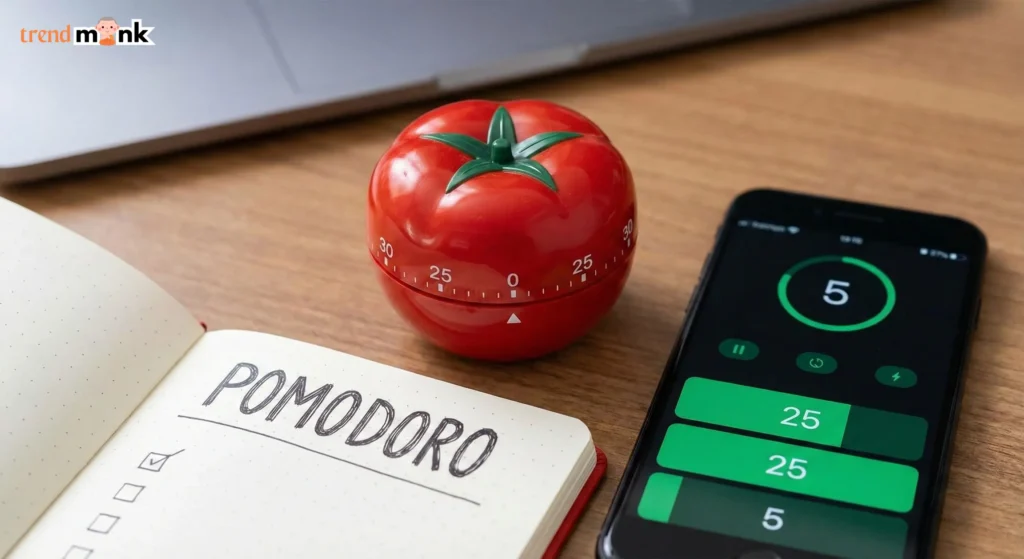
The Science: Attention wanes after 25-30 minutes.
Apply It: 25 min work / 5 min break. If in “Flow State,” extend to 50 mins, then take a 20 min break.
Lifestyle Factors: Fueling the Exam Brain

Your brain consumes 20% of your body’s energy. You cannot run a high-performance engine on low-grade fuel.
- Hydration: A 2% drop in body water causes significant impairment in attention.
- Omega-3s: Walnuts, flaxseeds, and fatty fish support synaptic plasticity.
- Aerobic Exercise: 20 mins of cardio releases BDNF (fertilizer for your neurons).
Expert Insights
— Dr. Jeffrey Karpicke, Cognitive Scientist
— Matthew Walker, Author of Why We Sleep
Frequently Asked Questions (FAQs)
Conclusion & Next Steps
Studying is not a talent; it is a technical skill. By shifting from passive re-reading to Active Recall and Spaced Repetition, you are aligning your efforts with your biology.
Your Next Step: Do not try to implement all 10 methods today. Pick one subject. Create a Spaced Repetition schedule for it and use Active Recall for your next session. Track your results.
Found this guide helpful? Share it with a classmate who is currently drowning in highlighters.